WELCOME IPS CHINA LIMITED

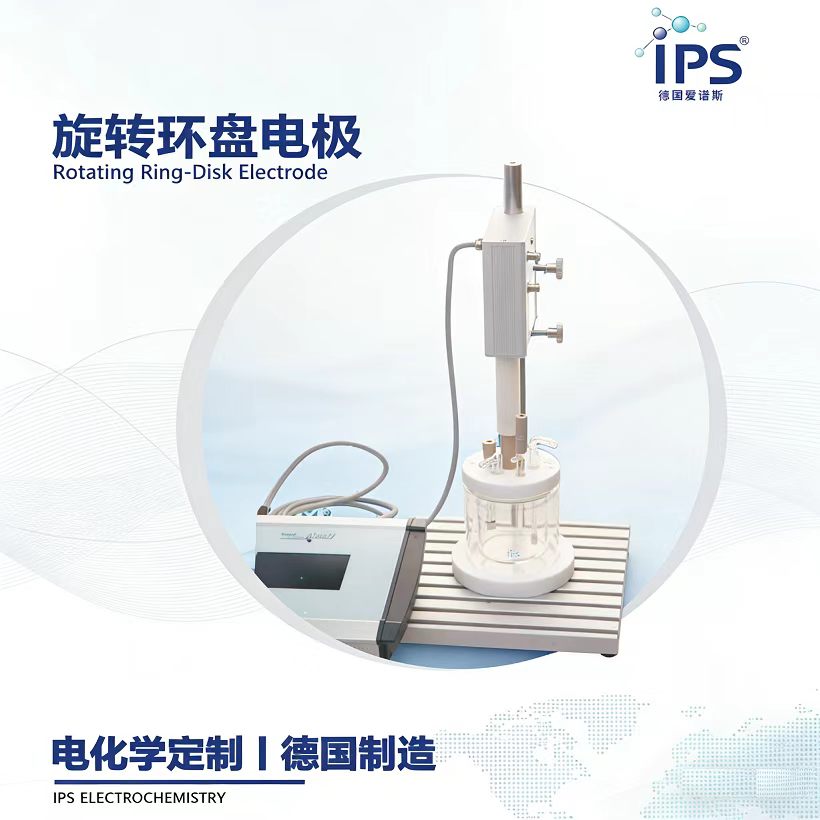
Rotating disk electrode is an important hydrodynamic electrode. The mass transfer process of liquid on the electrode surface can be accurately controlled by rotating the electrode itself. It is a very powerful and indispensable tool in copper plating, especially when it comes to basic research, process development and process monitoring.
Study on Electrodeposition Mechanism and Dynamics
Separation, mass transfer and reaction control: In electroplating, the current is limited by two processes: ion diffusion to the electrode surface (mass transfer control) and electron transfer/crystallization reactions (kinetic control). By controlling the rotational speed, RDE can create a stable diffusion layer thickness, thus separating the two controlling factors.
Determination of limiting diffusion current: By measuring the steady-state current at different rota tional speeds, the linear relationship between limiting diffusion current and the square root of rotational speed can be obtained (Levich equation). This is used to accurately determine the concentration of copper ions (Cu²) in the plating solution, the diffusion coefficient and the true electrochemically active area.
Study of nucleation mechanism: transient techniques (such as chronoamperometry) combined with RDE can analyze whether the electrocrystallization process of copper on heterogeneous substrates (such as gold, platinum, stainless steel) is instantaneous nucleation or continuous nucleation, which is crucial for understanding the initial adhesion and compactness of the coating.
Modern copper plating, especially copper interconnects in integrated circuits, relies heavily on complex additive systems (usually containing inhibitors, accelerators, and planarizers) to achieve bright, flat, void-free coatings. RDE is the "gold standard" for evaluating the performance of these additives.
Study on additive action mechanism: By comparing polarization curves before and after additive addition, the change of additive on copper deposition potential can be seen intuitively.
Inhibitors: usually cause an increase in polarization (deposition requires a more negative potential) and appear as a decrease in current on the polarization curve.
Accelerator: Usually causes polarization to decrease (deposition occurs at a corrected potential), manifested as an increase in current.
Quantification of competitive adsorption and synergistic effects: By testing at different rotational speeds, it is possible to distinguish whether additives act by affecting mass transfer (diffusion) or interfacial reactions (adsorption). Competitive adsorption and synergistic effect between different additives can be quantitatively studied.
Accelerator efficiency test: in the presence of strong inhibitors (such as polyethylene glycol PEG + Cl) background, after adding trace accelerator (such as SPS/MPSA), observe the recovery of current, can quickly evaluate the activity of accelerator.
 open the phone and scan
Copyright © 2012-2018 IPS CHINA LIMITED. all rights reserved 京ICP备19002103号-1
 简体中文
简体中文 English
 德语
德语